I live in a new subdivision where a bunch of neighbours are holding off building their fences and decks. It’s not only an expense most first-time new home buyers don’t consider, it’s also the price of lumber this year. The massive spike in prices has at least a half dozen of them thinking “next year.” But that’s all over with…but only in the U.S.
Lumber prices have collapsed, giving up all of their 2021 price spikes. But that’s only in the U.S. So, right now, you can buy lumber at 2020 (and lower) prices in the US, paying the exchange, duty and tariffs. Yet, here in Canada, there are so few retailers that they, along with the producers are taking their sweet time dropping prices. NOT nice!
Nobody expects 18-year olds graduating high school, or anyone half way through college or university, to be experienced at something. We don’t expect a high school grad to do the rough-in plumbing in an entire new house. We don’t expect a first year university student to do a full set of final architectural drawings, a pre-med student to diagnose a patient, or a future teacher to teach a junior high school class today. Why? Common sense: Because they haven’t finished their education and aren’t trained or experienced. That’s not an issue of “fault,” but an issue of timing and experience. They’ll get there – they’ll be great at it – just not today.
However, with money, credit and financing it’s exactly the opposite. OK, you’re now 18 or older – best of luck with student loans, how to pay for an apartment, how to save, manage your credit card, and/or knowing the five things to watch for before you buy a vehicle. That’s also not a “fault” issue – it’s an experience issue, too. But we know they’ll get experience in their career after high school or two or four years of university before we set them loose, start to expect things, and judge them. That’s all AFTER they’re fully done with schooling, apprenticing, training, and/or an internship.
The first, and pretty big, money, savings, credit and finance decision come at them the opposite way. They happen before they have any experience or knowledge. In other words: Make the decisions, sign the loan, use the credit card, decide on the overdraft, and THEN you’ll get the education. By then, the education is that they’ve messed up and made a lot of wrong decisions. In that case, they’re digging out of a hole for the next decade or longer.
That’s the exact opposite of how they get hired: First comes the education, qualifications, safety training, coaching, more training, and THEN we set them loose. As a result, most of these 18 to 25 year olds never had a chance.
However, in areas where the high school curriculum provides money, investing, and finance courses, the impact is pretty significant. In the U.S., there are eight states who do that. In surveys way after graduation, it shows that these kids have more in savings and investments, are way less likely to be in debt, to use or abuse credit cards, or ever go near payday lenders. They also have lower student loan balances, and pay them off sooner. So the key is to get them informed, because knowledge is power. And that’s back to the premise of not graduating them backwards.
Last week we talked about the dangers of that first credit card for someone who just graduated.
The same applies to banks getting you hooked on an overdraft or line of credit once you have some income. That overdraft will be there for at least a decade, and it’s not like you know how to shop around for the best loan deal or rate.
Car dealers also can’t wait to meet you. How many cars are you going to buy in a lifetime? Five, or six, maybe? Well, the average salesman sells that many in a week! So who do you think knows stuff and have the upper hand? It’s like bringing a plastic knife to a gun fight – you’re gonna lose, even if you bring one of your parents or a buddy.
So you’re all set. At some point you may have student loan payments for two decades, you’ve got the credit card, an overdraft, and a car payment. Grade five math says that majority of your income is now going to pay all that every single month – forever. So someone telling you save some money is just a pipedream.
Now you’ll be thinking about how to get rich for the next 40 years. But you’ve already forgotten how easy it really is to actually GET rich, instead of just wishing it. When you were still in high school you probably had a summer job. You worked hard, had a goal of what you wanted to do with that money and saved like crazy. Plus, because you had so little money, you were careful how you spent it, right?
But that was before graduation. Now you have a paycheck and access to borrowed money, so you’ve forgotten how to get rich already, and you’re just getting started. Let me remind you again and maybe, just maybe, you’ll do these things to actually get rich, instead of that coming 40-year dream:
Pay cash for stuff
Don’t buy crap you can’t afford and don’t need
Save at least 10% of your money right off the top
In your high school class maybe one or two people will do that. The rest will just be the people hoping to get rich, looking to the government to lend them a hand, or maybe the lottery will come through for them. I don’t know which group you’re in: The going to be rich, or the just ‘wanna be rich’ group.
Maybe someone in your family will print this segment out for you. Maybe I’ll see you at the top, or maybe I’ll get an email from you in 10 years or so to help you with some of your financial mess.
You’re an 18-20 something who is about to make a lot of financial decisions which will impact you for a lifetime – literally.
It’s Grad season again and this year, around 400,000 teenagers will graduate high school. According to Stats Can, there are over 2.1 million kids aged 15 to 19 and 2.5 million aged 20 to 24. But only one or two of those millions matter: Your son, daughter or grandkids.
The good news is that you can rest easy knowing their Grade 12 math taught them to solve trigonometric equations and to graph exponential functions. The bad news: They have no clue about overdrafts, the rule of 72, buying a vehicle, their first credit card, how to budget, manage money, the minefield of student loans or any other financing or investing.
If you’re between the ages of 17 to 21 or so, or have a son or daughter that age group, banks, car dealers, and especially credit card companies are salivating to meet them.
Those companies will do whatever it takes to get their business. Banks, and especially credit card companies, have THE best marketing minds in the country and want your teenager in debt to them – really soon and really deep.
We have a huge emotional attachment to our first credit card. It’s the reason they’ll do whatever it takes to be front and center in your teenager’s wallet. Once they’re first, they own you, and the memories and loyalties are way bigger than the teenager’s first boyfriend or girlfriend – and last a lot longer.
On average, we keep our first credit card for over 15 years. It doesn’t matter that the rate hasn’t been competitive for years, that the perks are junk, or the fees they add on. For this group, the default rates are below average because, in most cases, parents will step in and pay the balance, or at least make the payments.
Why do they target your age group? Because they can’t market much to your parents. Adults already have all the credit cards they need or want. So they can’t grow their business unless they get to you. It’s millions of fresh customers, and bonus: You don’t know squat about credit and the dangers of credit cards, but you do love to impulse buy.
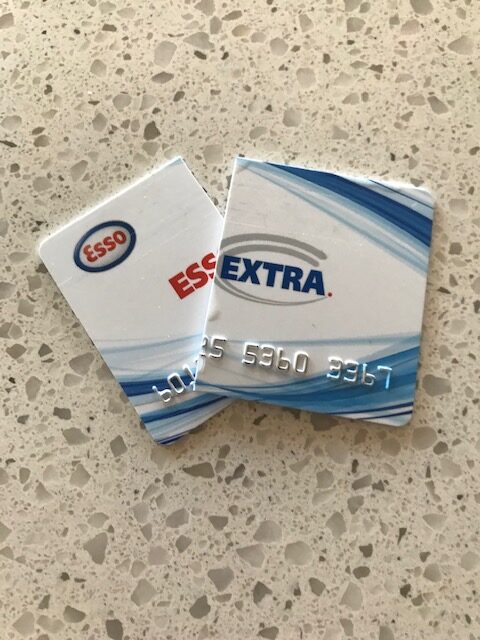
Add Esso to the retailers who have moved up their reward earnings needed this past month. After five years or so, I had enough points for a $50 gift card that I redeemed. But also had another 1,200 points. At 1,400 it was going to get me another $10 gift card before cancelling the card.
Nope – a $10 gift card now needs 1,800 points. As the closest Esso station is almost always 2 cents higher than anyone else. To get the 600 points, I’d have to spend $600 in fill-ups. But that requires overpaying 2c or $12 to get $10. Or overpay about 7 cents on average over the Costco gas bar five km down the road. That’d need $40 overspending to get $10.
In a week when the Edmonton Oilers play the Canucks four times and may well lose all four, maybe I have something that cheers up Canucks fans. Or makes them feel a little better about their team.
Part of Money 101 is pretty easy: Don’t get into bills that you can’t pay – don’t write cheques when you don’t have the money in your account. You’d think that’s pretty basic common sense.
When NHL teams are on the road they stay in 4 or 5 star hotels. Not bad to be in $200 to $300 rooms. In Dallas, a number of teams, including the Edmonton Oilers, stay at the Crescent Court. It’s in a very upscale area of Dallas called UpTown, with a discounted rate of US$261 or so.
That was the case for an Edmonton road trip December 16, 2019 with a bill of $28,000. Then again after another away game in Dallas March 3rd of 2020 for another $27,000 hotel bill. The good news was that the Oilers won the game that night (2-1). The bad news was that the team bounced the cheque to pay the December hotel bill.
To make matters worse, the Crescent Court hotel then didn’t get that bounced cheque (or thus the actual bill) paid for 11 more months, and never did get paid for the March bill just before the start of the pandemic and NHL shut-down. I suppose I have to keep saying “allegedly,” even though court filings are accurate, because lawyers can’t lie in court and court documents.
Yes, the hotel finally had enough and sued the Edmonton Oilers in court for the outstanding US$55,000 in November. That’s over a year after the first bill – not good. The matter has now been “settled.” I’m guessing settled should just mean “paid in full.” Plus, add the Oilers to the long list of businesses using the pandemic as an excuse for bad behaviour. “We face the same challenges as any business in the midst of a global pandemic.” That was the statement from the team. FYI: the unpaid bill was November 2019. That was four months before the pandemic.
A company with owner Daryl Katz (living in Vancouver by the way) who is worth $3.5 billion (according to Forbes) shouldn’t have this in the media. They should also have a better accountant, and an overdraft, or a bank that trusts them enough to cover the cheque even if that account is short. There are definitely more questions than answers here.
Conner McDavid is the Oilers captain. So I’d suggest he does the check-out at the hotels on his credit card. He’s responsible and reliable. That way the bill gets paid, and I’m sure the Oilers will reimburse him within days not months. Plus, he makes enough income to get the Amex Black Card with literally unlimited spending to make sure the charges on a long road trip go through. Sure, it’s a $7,500 first year annual fee – but it’d be a win win: He gets massive points and the Oilers get a massive reputational boost.
Wow, you’d think that after 15 years and almost 700 of our radio segments we’d have talked about everything by now. Not true – not even close – never in the world of money and finance!
Pop quiz: Is hiring a company for a $20,000 job to finish your basement considered a home improvement? Nope – probably not.
Is buying gum and hand cream at Lowe’s considered a home improvement purchase? Yup.
See – and you thought you knew!
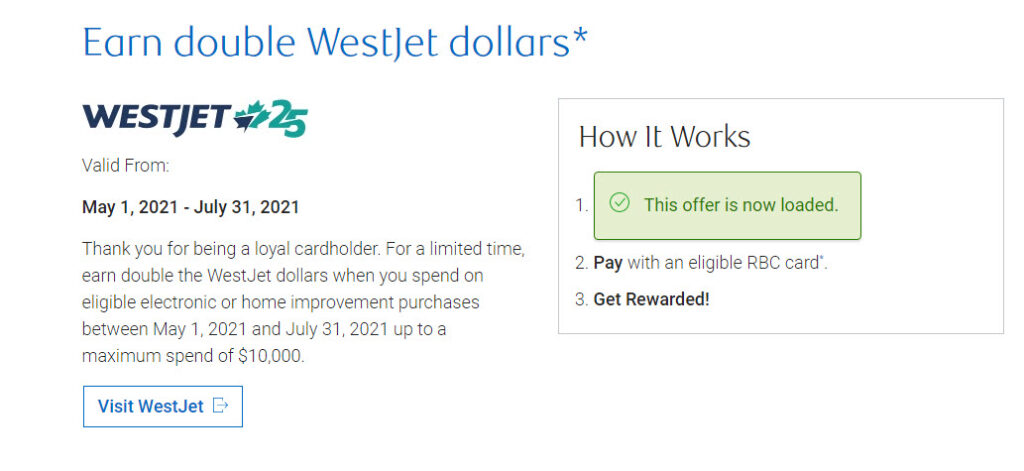
On Monday, the Royal Bank Westjet MasterCard (MC) started a double points (Westjet dollars) promotion on “eligible” electronics and home improvement purchases. Just after I bought $200 of treated lumber – it never fails…
Almost every card will have these promotions from time to time. But it’s buyer beware because the key word is “eligible” purchases. The hundreds of thousands of retailers and companies who accept credit cards all have a merchant category code (MCC) that identifies their primary type of business. My company is consulting – so it’s coded as professional services. That’s the same for accountants, dentists and the likes. So if you buy some lumber from your lawyer, or an “I love George Wednesday mornings” T-shirt, it’s still a charge in the category of professional services and not home improvements or clothing.
It is not what you buy that matters. It’s a charge in the right category that determines whether you get your bonus points for any promotion. A contractor won’t be coded correctly so your $20,000 charge won’t get you bonus points. But Home Depot, Lowe’s, Rona, Home Hardware, General Paint, or the likes are always coded home improvements. So whether you buy gum, lumber, paint, or appliances there, you’ll get the points.
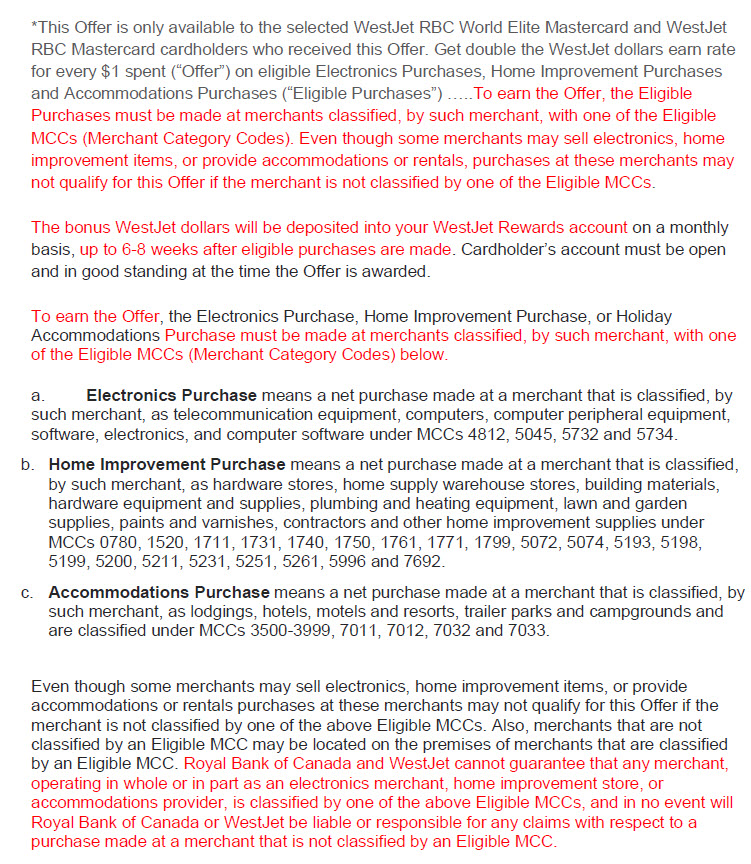
Here is the full disclosure on the bonus point offer. It took me almost half an hour and comes from three different places. Thank you Royal for the details, but would you look a half hour to find these when your card offers them?
-Your bonus points won’t show up on your statement for 6 to 8 weeks. By that time, any promotion is probably over and you won’t know if you actually got them.
-You can’t get the MCC code in advance to know if you’re buying the right stuff from the right merchant with the right code.
If you stick to the “obvious” retailers, you’re safe – but never sure. Here’s the disclosure. It’s the same for every points promotion but I bet you’ve never heard of seen it:
Home Improvement Purchase means a net purchase made at a merchant that is classified, by such merchant, as hardware stores, home supply warehouse stores, building materials, hardware equipment and supplies, plumbing and heating equipment, lawn and garden supplies, paints and varnishes, contractors and other home improvement supplies under MCCs 0780, 1520, 1711, 1731, 1740, 1750, 1761, 1771, 1799, 5072, 5074, 5193, 5198, 5199, 5200, 5211, 5231, 5251, 5261, 5996 and 7692.
Costco is considered a discount club with MCC5300 –Walmart is typically MCC5310 (discount store) or MCC5311 (department store) but they may also have a code set up under MCC5541 (groceries) – but that’s unlikely. So no bonus points there for any promotion from anyone – ever.
You could:
-Call your card issuer and ask for the MCC code for a specific retailer – but I doubt you’d get it.
-Check your old statements in case they’ve had the same promotion in the past where you can see what qualified.
-If you get an annual summary of charges (not with Royal Westjet) that will give you the spending under specific categories and you’ll be sure those stores qualify
Or do what most everyone does: Get excited about the promotion and charge away and hope you might get the points in the MCC code crap shoot.
Lastly, if any bonus offer ever has you buying from a more expensive retailer just to get the points, you’re tripping over dime to pick up a penny. You REALLY need to read the “what are your points really worth” on page 139 of the Money Tools book.