Category Archives: Blog

Tim’s Gets 250% Worse

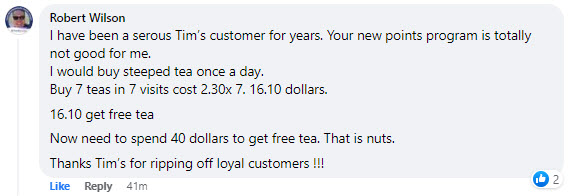
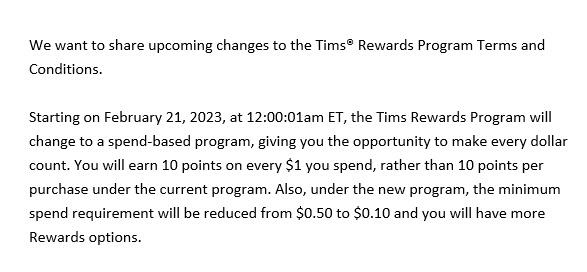
This morning, Tim’s is joining the long list of retailers who have changed (worsened & significantly dialed back) their “loyalty” program.

As all the others, it’ll now be spending money based, instead of number of visits. In my opinion, Tim’s is making a big mistake. Average coffee and re-heated bagels and muffins hasn’t worked for a number of years. Sure, Covid lockdowns didn’t help, but now changing their reward program to be 250% less rewarding isn’t going to help their business. People may go in for a coffee and end up with something else, as well. Discouraging the coffee crowd from coming in the first place seems like a pretty dumb step backwards. Maybe I’m mistaken and Tim’s knows how to upsell people who don’t come in in the first place?? But then, they didn’t ask me…but now I don’t feel so bad having switched to McDonalds coffee some time ago…

What Would You Do? Pay $40 Or Destroy Your Credit?

During a recent trip to downtown Edmonton, I purchased an all-day ticket from the lot’s dispenser, put it on my dashboard, grabbed my laptop, and left. Three hours later, after my seminar, I got back to my car only to find a violation ticket for $40 under my wipers. What the heck? I was choked! It turns out that the wind had blown the receipt off my dash when I opened the passenger door to get my laptop bag.

The majority of people would ignore the ticket, while some might phone the company and try to talk their way out of it. That may work, but I doubt it. The ticket wasn’t displayed so the fine was issued. Even if someone can talk their way out of it, unless they take the extra step of getting the ticket voided in writing, it will show up again.

Within a month, the collection letters will start to arrive. Then, a few months later, this will end up at a collection agency. After their hate letter, they’ll report it to the credit bureau. You now have a collection on your report. That will drop your credit score about 100 points if you had a decent score prior to this. In other words – it’s destroys your credit.

But the chain reaction gets worse: Your interest rates on your credit line and some new borrowing will now jump a lot! Sure, you can eventually pay the ticket. There’s even a small chance you can convince them to remove it. But it’s more likely it’ll just get changed from an outstanding collection to “paid in full”. And for the next three to six years this impacts your borrowing ability or rate.

Unlike most everyone else, I swallowed hard and paid the fine the same day. Expensive lesson learned – something I call a stupid fee. But a $40 lesson is a lot cheaper than thousands of dollars in higher rates, and years of credit problems.

A Vernon person emailed me the same kind of issue. He had collection letters he ignored and now the item is on his credit file. What can he do now? Pay it and learn a very expensive lesson for the next few years.

Would You Be Willing to Cancel Christmas This Year?

Well, maybe that’s a little extreme – but I’m just talking about the excess spending part of the holidays.

Whether it’s Covid, lockdowns, inflation or recession, on average, we spend more than $700 on gifts. But we’re already spending over 165% of our household income each year, and our savings rate is barely four percent. That means most of our holiday spending will need to go on credit cards. Ouch!

When asked, the average person claimed it took two months to pay off their holiday shopping. Yet the actual time was over six months! Let’s face it – July is NOT when you want to deal with last years’ holidays!

And it’s not just the gifts we buy, but also the added spending for trips, the tree, decorations, cards, postage, concerts, clothes, hairdressers, all that food, and the total amount quickly adds up.

So here are five tips to financial survival this years’ holidays:

 Cash is king – when you’re paying, there’s a very different feeling to laying a bunch of $20 bills on the counter instead of using a credit card. With a number of cards, there’s no reason to stop, and merchants know that the average purchase is much higher when customers pay with by credit card!

 Get realistic – make some kind of simple budget, stay within it, and practice the four most powerful words nobody ever wants to say: “I can’t afford it.”

 Know what’s important – resolve to make this holiday season less about money. Focus on the difference between the meaningful and the meaningless. This might be time with your family, a donation to your favourite charity, your faith, or many other things.

 Speed kills – it’s not just a traffic rule, but also includes your impulse purchases.  It will almost always cost you more money if you don’t take the time to shop around.

 Make a list and check it twice – it works for Santa, so discipline yourself as well. Don’t leave the house without a list and a good idea of what you’re looking for, as well as a price range. Cruising the stores is frustrating and many people tend to just buy something – anything – just to get on with it, and that’s never a budget smart way to make purchase decisions.

So-called “Good” Debt and Your Stay-at-Home Partner

BNN has previously featured a Bank of Montreal survey with the headline that Canadians are taking on more “good” debt. Oh nice. So everything is fine – nothing to see here – move on.

Give me a break. I understand the logic of what they’re saying, but I disagree with the premise that there’s really such a thing as “good” debt.

The survey called borrowing for the purchase of a home, to do renovations, or for education good debt. Well – maybe. But most of these CAN be done with cash and without taking on more debt. The only exception would be the purchase of a home. But only in comparison to taking on debt for vacations or credit cards, as two common examples.

News flash: At the end of the day you still need to make the payments. It’s “good” if the rate is really low, bad if it’s the 20% credit cards. But debt is debt. It stops or reduces the amount you can save, because you only have a finite amount of net income. So, every time you borrow, you’re taking a voluntary pay cut: Same pay, minus the necessity bills minus one more new payment now.

It’s good or at least “gooder” if it’s a fixed loan where you have three, four, or five years and there’s an end. It’s never good when it’s interest only, such as a line of credit where the average person owes over $35,000 and owes it for more than 14 years. It may have started off with the sales pitch that it’s “good” debt, but when you add up all the interest and time to eventually pay it off, it was a horrible idea.

And one more thing, if you have a spouse who is a stay at home parent with your kids: A new study just found that a stay at home parent would be fairly compensated at $117,000. So if your partner is a full time parent, do not begrudge them their “me” money, or question their personal spending unless you want to pay them what they ought to get paid! You really need to read the Money Tools relationship chapter: When you got married, it stopped being  “your” money or “their” money and became “our” money.

The Traps Of No Payment No Interest Offers

From time to time you’ll see an offer from electronic, home improvement, or furniture retailers for a no payment no interest plan. These promotions are especially popular November to March when people typically don’t make expensive purchases.

Buy today and don’t pay for 12 months with no interest is usually the headline. Setting aside the problem that our brain tends to think that means it’s “free,” and we tend to be wildly optimistic that it won’t be a problem to pay off, you need to be aware the no interest part is really tricky.

These finance offers are handled by large finance companies, and not by the retailer you’re shopping at. Most commonly, it’s GE Consumer Finance. If you buy $3,000 on the no interest no payment plan, you have to pay it off before the 365th day no matter what. One day after that, the interest at usually 30% is charged retroactively to the day of purchase.

In other words, an hour late costs you the full interest at about seven to 10 times the rate of your credit line, and close to double your credit card rate, or $900 interest. The no-payment part assures the vast majority of people don’t mail something in each month to reduce the balance. The typical thinking is why should they, it’s interest free. The problem is that the full $3,000 is hard to come up with in the last few days! Small wonder over 80% of people don’t pay it off and now pay the almost 30% rates, and that’s insane!

But there’s one more heads up that’s really nasty and you need to know: If you make your purchase on the 1st of December, the balance has to be paid off by November 30st next year. That makes sense – it’s one year. But it takes the store a few days to send the contract to the finance company. So their statement date will be the 4th or 5th of the month. So, a year later you see the statement that shows yours $3,000 balance with a due date of December 4th. However, that’s your statement date and NOT your end date for the no-interest!

Stay away from these types of offers. If it’s the only way you can afford it – you can’t afford it. If you play with fire, one of these days you will get burned. But, if you ignore my advice, and don’t want to get burned badly, divide the total amount into 10 or 11 months, and send one-tenth or eleventh of the balance each month. It’ll make sure you’re paying it down and never get near the deadline and the 30% rate.

Another Grocery Price Hike? Make It Stop

Sometimes to my detriment, my personality type is that I’m very loyal and a creature of habit. However, when it comes to the regular items I buy in the grocery stores, that’s come to an end this year.

Sure, there’s grocery inflation, but there’s also a lot of “taking advantage” and outright price gauging. I don’t know what’s what, but I do know when to say enough is enough and switch brands. That’s actually not hard to do, but you first need to acknowledge that you have a loyalty problem and that other substitute products are likely just as good…and a lot less expensive.

Whether it’s habit or your budget, if you stop buying the products that have gone up a seemingly unreasonable amount, and enough other people do the same, the price will come back down. It’s simple economics 101 of supply and demand.

For me, it’s these items that I’ve had to say goodbye to – but have found other substitutes just as good:

Walmart Becel margarine up 30% (6.45 to 8.99)

Costco Pita Bites up 30%

Loblaw (No Name) Suraj mango juice up 60% (1.25 to 2.00)

Loblaw (Presidents Choice) Belgian waffles up 30% (5.00 to 6.50)

Walmart Great value wafers up 40% (1.00 to 1.40)

Costco Almond crunch cereal up 40% (10 to 14)

Another Half Percent Rate Increase

10 minutes ago, the Bank of Canada announced another half percent rate increase – and they’re not done, yet.

At the start of the year, the Bank of Canada rate was 0.25% and the housing market was humming. That’s come to a crashing halt. The days of multi-offers are pretty much over and it’s taking a number of price drops to sell a home in most markets.

Keep in mind that “average” statistics for housing across Canada are totally useless. A small stable market isn’t impacted, while Toronto, Montreal and Vancouver will certainly see the brunt of the price drops and reduced sales. In between are a vast variety of different cities with a wide variety of factors and impact.

You also need to remember that the Trudeau stress-test is still in place. At the start of the year, someone with an $85,000 income could qualify for a $500,000 mortgage. Today, that would take an income of $113,000. And that’s assuming no other debt of any kind. Since nobody I know received a $28,000 annual raise, the person needs to find a much less expensive home or stay on the sidelines until rates drop (which won’t be until 2024) or prices come down – way down.

Since the housing sector is such a huge part of our economy, you can bet on a recession. But this recession won’t have the Bank of Canada dropping rates to resurrect the economy. They’re entirely focused on inflation. It’ll be a significant slow-down in the housing market, then a recession resulting in job losses without any help from the government or Bank of Canada until late 2023 or 2024.

Much like the imbalance in the car market for the past two years, it will likely turn out to be a great decision to put off buying a home for the next year or two…

Giving Cash to Your Adult Kids?

I’m a big fan of giving money to your adult kids. It allows you to be a blessing to them and to be able to help, where appropriate. But only if you can afford it, where it does not impact your lifestyle or emergency funds, and giving it smartly.

There’s an entire chapter in the Money Tools book entitled: If you’re the parent of a kid aged 4 to 40. It’ll explain how to help, and how not to help your adult children with money, to never cosigning any loan, etc. It’s a must-read for everyone with adult children.

In addition to that, there’s more you should do – or not do: Never pay off, or pay down their credit card. 80% of people run them right back up within a year. And, sorry, your kids won’t be the exception. Since they clearly can’t handle credit cards, they’re better off at the max so they have to stop using it. When they do pay it off, it’ll be really hard – and that lesson will last a lot longer.

You do have a right to designate the money. No, you’re not intruding. It is YOUR money and YOU get to have a say in how it is used! If you end up being wise enough to set conditions, give them a note outlining what you’ll do, because you’re not going to be just handing them a cheque Christmas day.

A blessing could be a fixed amount for a down-payment for a home. Or many families make it a match: We’ll contribute $5,000 when you have $5,000 saved up – just show us your savings account balance. Or it could be partial payment towards a vehicle. We’ll add a $3,000 down payment for a vehicle, or pay one-third or whatever of a good used vehicle that you can afford to pay for without financing.

For the non-adults, if you’re giving cash to the grandkids, the most powerful way is to make it an investment contribution. Your kids will just need to make sure your grandson or granddaughter have a Social Insurance Number and they need to open an investment account. With historical returns of 10% (yes, both the Dow and S&P500 did better than that even in a crappy 2016 investment year) the money will double every seven years. If you invest $2,000 for a 5-year old, it’ll be $8,000 at 19 when they go to university. $5,000 will turn into $20,000. If it’s longer term and for retirement, that’s 50 years the money can keep doubling and doubling: $1,000 turns into $145,000 and $2,000 today turns into $290,000 at retirement. THAT is a small present, set up correctly, and invested wisely, that you can’t beat.