Author Archives: George Boelcke

Another Grocery Price Hike? Make It Stop

Sometimes to my detriment, my personality type is that I’m very loyal and a creature of habit. However, when it comes to the regular items I buy in the grocery stores, that’s come to an end this year.

Sure, there’s grocery inflation, but there’s also a lot of “taking advantage” and outright price gauging. I don’t know what’s what, but I do know when to say enough is enough and switch brands. That’s actually not hard to do, but you first need to acknowledge that you have a loyalty problem and that other substitute products are likely just as good…and a lot less expensive.

Whether it’s habit or your budget, if you stop buying the products that have gone up a seemingly unreasonable amount, and enough other people do the same, the price will come back down. It’s simple economics 101 of supply and demand.

For me, it’s these items that I’ve had to say goodbye to – but have found other substitutes just as good:

Walmart Becel margarine up 30% (6.45 to 8.99)

Costco Pita Bites up 30%

Loblaw (No Name) Suraj mango juice up 60% (1.25 to 2.00)

Loblaw (Presidents Choice) Belgian waffles up 30% (5.00 to 6.50)

Walmart Great value wafers up 40% (1.00 to 1.40)

Costco Almond crunch cereal up 40% (10 to 14)

Another Half Percent Rate Increase

10 minutes ago, the Bank of Canada announced another half percent rate increase – and they’re not done, yet.

At the start of the year, the Bank of Canada rate was 0.25% and the housing market was humming. That’s come to a crashing halt. The days of multi-offers are pretty much over and it’s taking a number of price drops to sell a home in most markets.

Keep in mind that “average” statistics for housing across Canada are totally useless. A small stable market isn’t impacted, while Toronto, Montreal and Vancouver will certainly see the brunt of the price drops and reduced sales. In between are a vast variety of different cities with a wide variety of factors and impact.

You also need to remember that the Trudeau stress-test is still in place. At the start of the year, someone with an $85,000 income could qualify for a $500,000 mortgage. Today, that would take an income of $113,000. And that’s assuming no other debt of any kind. Since nobody I know received a $28,000 annual raise, the person needs to find a much less expensive home or stay on the sidelines until rates drop (which won’t be until 2024) or prices come down – way down.

Since the housing sector is such a huge part of our economy, you can bet on a recession. But this recession won’t have the Bank of Canada dropping rates to resurrect the economy. They’re entirely focused on inflation. It’ll be a significant slow-down in the housing market, then a recession resulting in job losses without any help from the government or Bank of Canada until late 2023 or 2024.

Much like the imbalance in the car market for the past two years, it will likely turn out to be a great decision to put off buying a home for the next year or two…

Giving Cash to Your Adult Kids?

I’m a big fan of giving money to your adult kids. It allows you to be a blessing to them and to be able to help, where appropriate. But only if you can afford it, where it does not impact your lifestyle or emergency funds, and giving it smartly.

There’s an entire chapter in the Money Tools book entitled: If you’re the parent of a kid aged 4 to 40. It’ll explain how to help, and how not to help your adult children with money, to never cosigning any loan, etc. It’s a must-read for everyone with adult children.

In addition to that, there’s more you should do – or not do: Never pay off, or pay down their credit card. 80% of people run them right back up within a year. And, sorry, your kids won’t be the exception. Since they clearly can’t handle credit cards, they’re better off at the max so they have to stop using it. When they do pay it off, it’ll be really hard – and that lesson will last a lot longer.

You do have a right to designate the money. No, you’re not intruding. It is YOUR money and YOU get to have a say in how it is used! If you end up being wise enough to set conditions, give them a note outlining what you’ll do, because you’re not going to be just handing them a cheque Christmas day.

A blessing could be a fixed amount for a down-payment for a home. Or many families make it a match: We’ll contribute $5,000 when you have $5,000 saved up – just show us your savings account balance. Or it could be partial payment towards a vehicle. We’ll add a $3,000 down payment for a vehicle, or pay one-third or whatever of a good used vehicle that you can afford to pay for without financing.

For the non-adults, if you’re giving cash to the grandkids, the most powerful way is to make it an investment contribution. Your kids will just need to make sure your grandson or granddaughter have a Social Insurance Number and they need to open an investment account. With historical returns of 10% (yes, both the Dow and S&P500 did better than that even in a crappy 2016 investment year) the money will double every seven years. If you invest $2,000 for a 5-year old, it’ll be $8,000 at 19 when they go to university. $5,000 will turn into $20,000. If it’s longer term and for retirement, that’s 50 years the money can keep doubling and doubling: $1,000 turns into $145,000 and $2,000 today turns into $290,000 at retirement. THAT is a small present, set up correctly, and invested wisely, that you can’t beat.

Cash Collateral Loans

I’ve been using this trick with people for a lot of years, but I realized we’ve never talked about it. It’s an inexpensive way to start building credit, to re-establish your credit, or to save a ton of money for people who can’t seem to save on their own.

Would you lend me $100 if I gave you the $100 cash for collateral? Of course – because there is no risk or downside, and your profit is the interest you’ll make from me on the loan. Credit unions do these so-called cash collateral loans, and a few of the banks do, too.

If you’re starting to build credit, it’s most likely you’ll do it with a credit card. But good credit is two years or more with a higher limit. A new card with a $500 limit gets you started, but it’s a tiny risk, thus a very small start to building credit.

Anyone who has had a bankruptcy also isn’t going to be able to borrow for at least three years or so. If you’re discharged from bankruptcy or have no credit, go to a credit union for one of these loans. It’s also in the Money Tools book chapter of: How to rebuild credit. Get a $2,000 loan set up over 12 or 18 months and give them the loan money as collateral. You’ll make the payments at a low interest rate and, at the end of the term, get the $2,000 released back to you. At that time, you’ll have a great start to a rebuilt credit record, and for a good-size amount of money (called high credit). The larger the loan, the more it will boost your credit rating. But you have to be able to make the payments – each and every month!

It also works the same with an RRSP loan but you need good credit to get one. By tax law, the lender can’t use the RRSP for collateral if you don’t pay.

These cash-collateral loans also work for the wealthy. You’d be amazed how many of them have the cash flow to make their payments, but don’t save. I had one person last year that was going to get an $8,000 a month whole life policy. It’s meant to give an insurance policy and build in an investment component, but it’s one of the worst financial product ever invented!

A term policy for his family was about $500 a month, and the other $7,500 payments towards a loan would get him the same $2 million insurance, and $200,000 cash in his hands at the end of a two-year loan!

How the Rich Spend Their Money..and Go Bankrupt


If you’ve ever wanted an insight into what rich people do with their money, here it is. It’s a research report from Personal Capital of over 50 NBA players. In some ways, they’re not so different from you and me. In other ways, you definitely don’t want to emulate what they do!

The average income is around $45,000. THAT is roughly what the average NBA player SPENDS in a month! But then, the rookie entry salary in the league is $4.7 million. But let’s see what they spend that half a million on every year:

11% goes to clothing and shoes – their biggest trackable expense category.

9% is automotive – even though most of them likely get a free vehicle from a dealership in return for some endorsements.

8% is travel – after all, it’s a long off season, and they like to travel in style, and to 5-star hotels and resorts, which isn’t cheap.

Restaurants eat up 7% of their spending. That’s around $35,000 a year, which will get you some great meals, even if you’re picking up the tab for others in your group.

Sadly and surprisingly, 7% is also what they donate to charities. That’s kind of a puny percentage for an income of more than five million bucks if you ask me.

5% goes to a category called service charges and fees. It’s kind of obvious here that over $25,000 of fees means they’re really not very financially literate, and certainly don’t shop around at all.

The one place they do seem to want to save money is shopping at Walmart. Yes, the average NBA player shops there, too – to the tune of over $45,900 a year!

But here’s where you want to be very different than an NBA player: Over 78% of them go bankrupt within two years of retiring from pro basketball. We spend what we make – that is: we spend to the amount of our pay. That’s not a good idea for us middle class earners or millionaire income athletes.

Yes, there are stories of pro athletes who are incredibly great savers and literally don’t spend a dime of their salary. But for every one of them, there are dozens who crash and burn. Vin Baker made over $100 million in his career and last month started a job at Starbucks to support his four kids. For millionaires and ourselves: Spend what you want, but only AFTER at least 10% comes right off your check, or out of your account, to pay yourself first.

The Free Way to Save $600

In June, I shared a Facebook story that a full 2 l bottle would hold $500 worth of dimes. So I decided to try it with every type of coin. Good news and bad news: I did fill the bottle inside of five months. It was easy for me, because I’m a small purchase cash guy. I don’t use debit cards for every two dollar purchase. The bad news? The full bottle was just over $600 in total. At first I was quite disappointed. Then I realized dimes take up a lot less space than loonies and toonies. But, what the heck, 50% of Canadians can’t save one week of net pay. This accomplished it and didn’t really cost me anything at all! The next bottle is now in use!

p1050594_full-coin-2-litre-bottle-pic

If Time Is Money…

Do you remember the old saying: Time is money? In lots of ways, it was and certainly is true. But does it apply to watching TV or being on social media?

In 2022, the average person spent just short of two and a half hours a day on social media. Whether it’s Twitter, Facebook, Instagram, YouTube or wherever, that’s a staggering amount of time. And that’s an average – so there are just as many people who spend five hours as there are those who aren’t using any of them. If time is money, that’s a huge part of the day that isn’t productive. That’s why I find it funny when I keep hearing on commercials, interviews or wherever the constant theme of: In our busy lives… Sure everybody’s busy. But busy doing what?

That doesn’t even include the time we spent watching TV. And yesterday I heard some pretty surprising stats for those of us who watch sports on television. These are the average times of ACTUAL play by play. Not the commercial, jibber jabber, replays, panning the crowd or the sidelines. Just the total broadcast time of the actual play:

Soccer game: 58 minutes

NHL hockey game: 53 minutes

NBA game: 49 minutes

Major league baseball game: 22.5 minutes

And the biggest time-waster of all sports on television? Pro football at 18 minutes of actual playing time!

To Downsize Or Not?

Here’s a great question that’s worth sharing and thinking about for any of us within 10 to 15 years of retirement:

“I was wondering if you could give your opinion on which direction my husband and I should take?   At what point does it make sense to sell your home and downsize? Financially, we are sitting home with an outstanding mortgage of $300,000. Our home value is about $725,000. We are both in our 50s and will be relying on the equity made on our home to fund our retirement. I will have a small monthly company pension and my husband will not. My question for you is, do we try and sell our house now and pay off half our mortgage/credit line? Or would it be financially better to remain in our home for another 10 years or so, and chip away at our mortgage?

Sadly, the answer is: I don’t know. I can’t answer that for you because the critical part is the answer to what the value of your house will be in 2032. If anyone claims to know that, they’re lying to you. I can’t even get more than three lottery numbers right so I’m not the one to ask.

You need to remember that I only ever answer questions, or talk about stuff, in terms of what I would do because I don’t ever have all the information. In my case, I don’t have any pensions and my house is up for sale in order to downsize significantly.

Half the world would ride it out and hope for a much higher value. The other half more conservative and risk averse group would downsize and reduce the debt, the interest that’s needed to carry it, and lock in the guaranteed $725k value by selling.

But lots of that depends on what degree of downsize. Using your math, it’d be about $1500,000 on the new condo, house, etc. Would that, divided by 10 years, be workable? Would those payments guarantee that you’ll be debt free in 10 years when retiring? If so, that’d be a huge saving.

After all, whether you make more income in retirement or have LESS debt to pay, it amounts to the same thing…actually it’d be more valuable as income is taxable, paying off debt isn’t. That’d be like an extra $1,500 in retirement that’s not going to the mortgage!

Gamble the house is $850,000 in a decade and that any correction comes and goes in that cycle, that there’ll be no correction, or take the money and run? That’s entirely up to you two and your comfort zone.

I do know that you can’t eat your equity. In other words, the equity isn’t something you can use unless and until you do sell. So the day will come…but when?

And Another 3/4 Percent Rate Increase

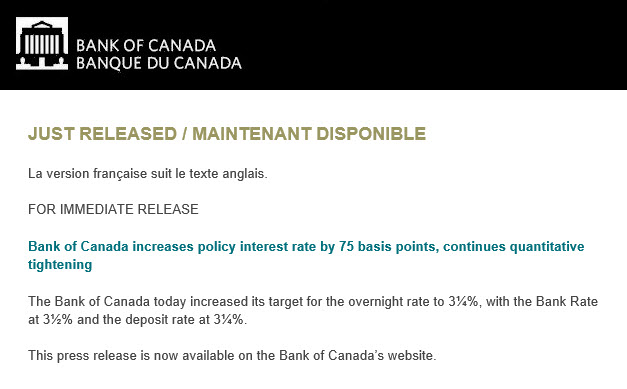
As predicted, the Bank of Canada increased interest rates by another three quarter percent this morning.

Hopefully you were able to get an early mortgage renewal as we talked about two weeks ago. Or at least passed on the heads-up…

If you’re not anywhere near renewal – many of us are envious. Even more so if you don’t have a mortgage in the first place!

On a $400,000 mortgage, for example, today’s change will increase a mortgage payment by $250 a month (or $62.50 for every 100,000 of mortgage balance). Between the rate increases and the Trudeau stress-test there aren’t going to be many first-time buyers that will have any chance of qualifying for their first home.

How sad that the Federal Government seems to have a single-minded focus on stopping home sales when it’s such a massive part of our economic activity from legal fees to home improvement stores, builders to realtors. Let’s hope that, at some point, they realize more supply would make a massive difference…but that’s not likely…