
Author Archives: George Boelcke

Financial Advisor or Adviser? It Can Cost You a Lot…and Your Cell Phone

Here’s a word that you have to know how to spell. If not, it can cost you tens of thousands of dollars. The word is advisor…or adviser. Two different ways to spell the same word and almost nobody notices the difference.

Almost all financial institutions now use this word for their formerly known as loans officers. But if you’re dealing with a financial advisor, you’re actually dealing with a sales person. If it’s advisor (with an e) it’s someone with a license, which you’ll see by their degree and designation. Those people need to act in the best interest of the client, it’s called a fiduciary responsibility.

If you’re going to buy a vehicle, a mattress, furniture, or jewelry – the items that are most expensive and/or have the largest markups – do you want to deal with a close family member or a stranger? The family member, of course. Because you can trust them a lot more than a stranger trying to close the deal and make the commission.

Banks are for parking your money and not for investing. But, since the majority of Canadians are going to ignore that fundamental advice…would you like to deal with a sales person or someone who has your best interests in mind? If you need an easy way to remember, think of the “o” in financial advisor as “oh oh…you’re about to get sold!”

The difference in your investments is whether it benefits the financial institution or you. And that can quickly add up in the front or back loaded mutual funds, the fees, the type of investments, the person’s investment knowledge, and the type of investments they recommend based on your needs and goals…or maybe on an internal bonus system or steering you into their managed funds. If it’s a GIC or something basic, it won’t matter. If it’s more than that – it matters a lot. Don’t spend a ton of time looking for the advisers (with an e) as they’re less than 7% of those jobs and it’s 93% plus that are sales people on commission.


Great news: The regulators of our phone services have come into the 20th century and have now made cars legal to operate in Canada. Yes, that’s rather sarcastic. But the point is that regulators move at the speed of glaciers. Unfortunately, that’s almost always to the detriment of our wallets and finances!

The Canadian CRTC has now mandated that phones be sold unlocked so you’re not a hostage to your current cell provider. That’s for new purchases starting in December. And current customers have the right to have their phones unlocked so they can fire their cell provider and become a free agent.

Plus, on family plans, the person who pays the bills now has to OK any data overages. You’d think that’s common sense, but ask the thousands of parents who have paid hundreds or literally $2,000 or more for data overages when their kids have just been able to press the “yes” button.
Sears, Amazon and Why We Can’t Do Our Own Investing

Ever wonder why retailers aren’t doing so well? Here’s a huge reason for it: Traditional retailers such as Sears, The Bay, Macy’s and the likes take 9 to 13 months to get a new clothing line from concept to production and into their stores to sell. Zella is a company with an extensive line of clothing. They can get an idea to production and into stores inside of two weeks! Two weeks versus a year. Wonder no longer why traditional retailers are fading quickly.

On the upside, Thursday Amazon announced they’d be selling Kenworth appliances online. Yes, Sears does have stuff people want – but now it’ll be online and in the U.S. only for the time being.

That announcement also shows why you and I really can’t do our own investing very well: When Amazon announced they’d be selling Kenworth, the stocks of other appliance retailers and manufacturers dropped by $12.5 billion collectively. From Best Buy to Whirlpool, Lowe’s, Home Depot, and the likes their stocks took a big hit. Now you and I may have figured out in a few days that, instead of Kenworth being gone, they’re now going to be a major player with Amazon behind them, but the Bay and Wall Street computers made the sell moves within a minute…

Speaking of investments, I’m going to make a bold prediction if you remember that I’m not an economist: The Bank of Canada can’t and won’t raise rates again until the U.S. does. The rate increase two weeks ago was based on thinking the U.S. would do one, too and they didn’t. The dollar is now way too high for our exporters and getting the dollar down is the main objective of the Bank of Canada. So they can’t do another increase, even if they wanted to, until the U.S. starts to raise them again.

Bad for savers, good for borrowers to get another reprieve…

Canada Post Financial and Eating Out at Lunch

Senator Elizabeth Warren has been promoting this idea for over a year in the U.S. But what about here in Canada? The post office is not exactly a growing business, but a very necessary one that isn’t making money, keeps charging more, and isn’t going to go away in our lifetime.

The post office is already a vast network of locations all across the country. They’re in remote areas that aren’t even serviced by a bank. Why can’t the post office sell prepaid debit cards, do cheque cashing, incoming and outgoing foreign money transfers to relatives, small loans and the likes?

Even if it just re-directs 10% of people from payday lenders or cheque cashing places it would save Canadians billions of dollars, rescue the post office and a ton of jobs there, become really convenient for people, and a new revenue stream.


Last year (2016) there were 430 million fewer lunchtime restaurant visits in the U.S. It has to be true in Canada, too, judging by the vast number of lunch ads from Boston Pizza to Subway, Tim’s and others. That’s a lot less eating out, or is it? Are we still buying at the lunch places but having desktop meals? That’s the slang for eating at your desk.

If you’re someone who has cut down, what I want to know is whether that money is getting saved, used to pay down bills, or just leaking out into some other “mystery” spending the rest of the week, in whatever, instead of food at lunch. Just because we eat out less, doesn’t mean we’re actually saving anything…

Visa Hackers & Free Banking

Researchers at Newcastle University found that criminals can hack your Visa card in less than 10 seconds. All they have is your card number and what they’re missing is the three digit security code and the expiry date.

With just a laptop and a simple computer program, they run all the possible combinations of your security code and the expiry. In just a few seconds they have all the information they need to start shopping online.

It only works with Visa who doesn’t have a blocking system when multiple tries are made with your card. MasterCard and Amex block the criminal after just a few incorrect attempts. Now don’t panic. You’re never liable if your card is misused – ever! But wouldn’t you think Visa would care about absorbing millions of dollars in fraudulent charges?

If you’re turning 60 or 65 this year, write a note on your calendar: You’ll be able to get much of your banking service charges stopped! Credit unions are at age 60, but you’ll have to check with your specific bank if they’re at 60 or 65. I do know the Royal is now age 65 as they just changed it. Ah, how to legally rip off tens of thousands of seniors for millions of dollars…it’s detailed in the Money Tools book in the banking chapter.

Daily Pay Advance?

The CBC just posted a story of a Vancouver (and Montreal office) start-up called Instant Financial. The business model is that companies can sign up with them to allow their hourly workers to withdraw up to half of their pay immediately after their shift ends. Mr. Mikes and McDonalds have already signed up with them.

Work your shift and get up to half the pay immediately. The rest is on your normal paycheque. My first reaction was: OMG – no – please – what a horrible idea.

The company is positioning themselves between a lender and payday companies. Nothing in the article, or anything on the company web site talks about the fees. But I can assure you, they’ll be significant and frequent! Clearly this is for hourly workers and a big benefit to companies with large numbers of hourly staff. There’s no chance their payroll department is in the town or city the workers are, and there’s no chance they’ll do hundreds of $50 advance cheques for their workers. So for them, it’s a third-party handling all that work and they just deduct the amounts from the pay just like they do for any staff charges from meals to whatever.

For the individuals, it’s very tempting, but horrible idea. Sure, lots of hourly workers aren’t blessed with a lot of savings. The company’s sales pitch is that this way they can access money for emergencies or to buy necessities. But $30 or $40 isn’t changing anyone’s life – no way. A $10 an hour worker, after an 8 hour shift can take out $30 tops. It’s 50% of their net pay max. The perceived need for this money today will come at around $5 or $8 in fees and will put a huge dent into their real net pay. Then, they’ll be heading to a payday lender to make up the rest of it to pay rent, car payments, their cell bill or other bills. I’ve seen it over and over and this “today benefit” will turn into the tomorrow nightmare. You can see that even with higher income earners when 25% of early RRSP withdrawals are for “daily bills.”

I read this story an hour ago. Give me another hour and I bet I can come up with a dozen alternatives at no cost and no pain. Big picture, employers are fine with their staff being broke. It’s a great motivator to get them to come back to work next week and next month. For the quarter of (around) minimum wage workers that are still in school, they’re around 17 to 19 years old. They have no financial knowledge, and probably just as much discipline. That “today” advance will go for a trip to the mall or a pair of jeans – not necessities as the company wants to tell us.

For the rest of their target market, give me a group of the most broke, living hand to mouth people, and I bet I can turn their finances around within one or two pay periods. Can the most broke people start with an emergency savings account (see the Money Tools & Rules book page 222)? Of course. Can most broke people save $20 a month? Yes. So within a couple of months, they’ll have enough in emergency savings to avoid ever having to be tempted with this daily advance plan!

But companies don’t want that for their staff if the truth were known. But people need to decide: If they’re broke they can fix it, or compensate. This company helps with compensating and staying broke plan, but not fixing.

Greetings from Aruba!

Yes, this week I’m in the Caribbean enjoying 80 plus degrees, and heading for a partial Panama Canal crossing on the Norwegian Pearl. Typically, a full crossing is a cruise from LA to Florida, or the other way around. However, many cruise lines, including Norwegian, now do these partial crossings that start and end in Miami. They’re rather expensive, as they’re 11 day cruises, but well worth it for anyone who has always wanted to see the Panama Canal.

The Pearl is a mid-size ship with 1,200 cabins and 2,400 passengers. That’s what you want, instead of the massive 4,000 passenger ships that are becoming the norm with most cruise lines. On the other extreme, my best friend will only go on a cruise with lines such as Viking that have only a few hundred passengers – but there’s a big price to pay for that.

I do have to confess that it’s my sixth time on the Pear, as it’s still one of my favorite ships. But if you’ve never cruised before, you really want to get the expertise of a cruise specialist with a local travel agent. Different cruise lines, just like different ships, have a very different personality – and for extended cruises, that matters a lot. Many Norwegian cruises have an average passenger age in the 40s. This one, for example, is likely in the 60s due to the length, and non-spring break time of the trip.

The Pearl has also just undergone a two-week dry dock renovation. About half the upgrades were age related, and something you wouldn’t notice. (Could you tell that the original railings are teak, and the replaced ones are spruce?) The other half are quite nice and noticeable. All cabins had a make-over, the most common traffic areas have new carpets, and some of the (pay) specialty restaurants were given a make-over as well.

A couple of heads-up as you might as well learn the painful lessons of someone else (that would be me), instead of on your own:

Within two hours of being on board, it turns out six of my well planned out dinner reservations made two months ago had been wiped out, and were gone. One other had been moved by three days, and only one of eight was still showing. As some of the popular specialty restaurants fill up early, that would have destroyed my vacation in the first few hours. The only reason I was able to get most of them restored, with the help of an incredible hostess who spent an hour helping me, is that I had printed the confirmations and brought them with me. If not, it would have been my word against the ship’s computer, and there’s no chance I would have had them re-booked. Print and take everything! The ship’s hotel director chose not to respond to multiple requests for an explanation or what passengers should do – as I wasn’t the only one. Trust me, I’ve heard the horror stories from almost all cruise lines. And, as I always tell you: If it’s not in writing – it didn’t happen! That will always be true: Case in point that 8,300 of my casino reward point (which is a lot) also disappeared. But with no written proof, I’m out of luck so to speak.

The second heads up is even more valuable: We talk about it at least twice a year: Loyalty is dead. From credit card programs to Starbucks, airline frequent flyer programs to cruise lines. Norwegian Cruises has a pretty high loyalty level called “platinum” that applies at roughly a dozen cruises. This cruise, my traveling companion had also reached that level. But what you don’t know in advance is that none of the worthwhile “rewards” are passed on to the second person. Yes, I get a free load of laundry – he doesn’t. Yes, I get a complimentary dinner – he doesn’t. The value of reaching that loyalty level for the second traveler is $1.25. It’s their own bottle of water in the cabin for the week.

If you have a regular travel buddy, or travel with your partner, make sure you stay a free agent in not always booking with the same cruise line. They get the revenue, but you don’t get the rewards.

Bank Staff Speak Out: You’re the Prey

This past week, CBC Go Public did an investigative report on the incredible pressure front-line bank staff have to sell products. They mentioned two banks, but this isn’t about those two – they all do it. I have a friend that worked for a third one until she got out, and she confirmed the accuracy of the story. Plus, a few weeks ago, we talked about a fourth bank that charged a Kelowna couple over $25,000 in life and disability insurance on their credit line for more than 20 years.

So don’t focus on the bank, focus on the story. The what, why, how to protect yourself, and what to do is a full chapter in the Money Tools book. It really is worth the trip to Mosaic and the $20 – this is just another of many reasons.

Front line bank staff have always had a bonus or commission for sales. But low interest rates have now put a major squeeze on them. One described it as: A choice between keeping my job and feeding my family or doing what’s right for the customer. That starts with selling basic chequing accounts that they have for four bucks but jamming the customer into the $29 monthly fee. It means pushing credit cards right at the teller, and the constant drive to sell the really bad financial traps of overdrafts.

It starts when you show up at the teller with your ATM card. The screen will come up with their so called “Advice Opportunity” to sell you something. One teller shares that “customers are prey to me. I will do anything I can to make my sales goal.” A number of employees confirmed that elderly customers are their common target because they’ve grown to trust their bank for years.

Go Public did a number of hidden camera tests in Vancouver. They found one teller offering to activate overdraft coverage without saying anything about the fees. Another opened a $15 a month chequing account, never mentioning that the $4 one would have done the same thing and suggested opening two more accounts. And so on and so on…

Longtime employees shared that they feel like used car sales people. The story also covered a number of long term staff who have quit because of the incredible pressure to sell, sell, sell.

I guess almost $2 billion in profits each quarter just isn’t enough. It’s sick, sad, and bad. Banks are not your friend – I’ve talked about that for decades. And a note to the professor who stated this will come back to hurt the banks: I wish you were right, but you’re not. There are only five major banks. They all do it. Unless someone moves to a credit union, they’re in for the same treatment across the street at the other four.

Here is the link to the CBC story: http://www.cbc.ca/news/canada/british-columbia/td-tellers-desperate-to-meet-increasing-sales-goals-1.4006743

The Latest Short-Term Loan “Deals”

OK, there should really be a sarcasm font on this. When I say “best deals” it’s actually the so-called best of horrible ways to borrow.

However, millions of Canadians look for short-term money every month. And they’re not just people who are down and out.

I filed my income tax return last Monday. I’ll have the refund cheque in my hands by early next week. That’s incredibly fast, yet millions of people can’t wait even a week (with direct deposit)? H&R tax refund advance rates are 15% on the first $300 and 5% on the rest. So on a $2,000 refund, they’re taking $130 to save you a week of waiting. That’s nuts and translates to an annualized interest rate of 338%.

They’re everywhere, but an Edmonton pawn shop is advertising a special on the radio: Only 25% if you redeem the item you pawned within two weeks. That’s supposed to be a deal? It’ll cost you $125 to get $500 for two weeks. That’s an annualized interest rate of 650%.

There’s a new website advertising nationally called lenddirect. The ads show a lot of smiling people that they can now get a convenient loan with just a few clicks online. The tiny tiny print shows the interest rate of 46.93%. On a $10,000 loan over five years, that’s $16,100 interest.

Not to be outdone, Money Mart has now expanded from the payday lending business model to also offer installment loans up to five years and $15,000. Their ads and website heavily harp on the fact that they have no hidden fees. Well, that’s reassuring. But you need to dig a long way down their website links in order to find the interest rate: It’s 59.9%. On that same $10,000 installment loan, your five year payments would be $528 and borrowing $10,000 costs you $21,700 interest. Yes, borrow $10,000 – pay back almost $32,000!

Borrowing from any of the short-term lenders really does make things worse – much worse, and not better. Sure, today you have a few bucks to relieve some financial stress, but it comes at a staggering price of a ton more debt and stress down the road. There are always alternatives, such as an overdraft, take a cash advance from your credit card, get an advance on your pay or holiday pay, borrow from a family member, or just be late on the bill that you have to pay today.

Paying Less This Year & Saving $1,400 the Easy Way

Some Things That Will Cost Less This New Year

4K Televisions: If you haven’t seen one, you should. The resolution is two or three times better than a high definition TV. But these 4K TVs were in the thousands of dollars just a year or so ago. They’re dropping quickly – as everything in electronics does! Walmart in the U.S. now has the Avera 49″ for $249. That won’t be the Canada price, but you can use it as a guide.

Small cars and sedans: California sells in a month what Canada sells in a year. So the U.S. sets price trends and U.S. customers are still buying SUVs and big vehicles like crazy. That makes you crazy smart if you buy a small car or sedan that isn’t selling. They’ll see price reductions and rebates the entire years. And you’ll be even smarter if you buy a two or three year old!

Some groceries: Beef, veal, fruit, and eggs should see a decrease this year, according to the department of agriculture. That’s assuming normal weather and, in the case of most fruit, a stable exchange rate.

Certain Apple products: If you’re an Apple fan, the second half of the year should bring a bunch of price drops on Apple computers, iPads and phones. And what nobody seems to know is that the Apple website has a hidden section where you can get refurbished products right from the manufacturer at great prices!

Airline tickets: According to Expedia,  2017 will give you lower prices and more selection. Supposedly prices should be those of 2012, which would be great! Anecdotally I’m seeing that already with three flights I booked in the last week.

Cell plans: Rough rule of thumb is that you need to re-shop your cell plan every 18 months or you’re probably overpaying! The competition is heating up again, in the U.S. any contracts are gone, and Wind is trying to increase their business a lot since Shaw bought the company!

52 Week Saving Challenge

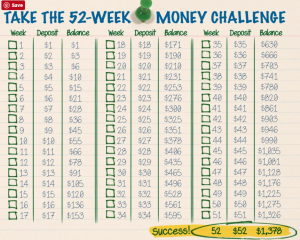
Can you save three dollars this (third) week of January? OK, can you save four bucks next week?

The 52 week saving challenge was put out by the budgetnista blog. The challenge is to save a dollar in the first week, and add a dollar for each week after that. You’ll have almost $1,400 saved at the end of the year – one dollar at a time. I don’t know about you, but that’s a lot of money, and it starts with a buck.

Yes, it’ll be harder in week 40, because you’ll be saving around $200 or so come October. But is having a $1,400 savings account worth it? Only you can decide.