Category Archives: Blog

Visa Hackers & Free Banking

Researchers at Newcastle University found that criminals can hack your Visa card in less than 10 seconds. All they have is your card number and what they’re missing is the three digit security code and the expiry date.

With just a laptop and a simple computer program, they run all the possible combinations of your security code and the expiry. In just a few seconds they have all the information they need to start shopping online.

It only works with Visa who doesn’t have a blocking system when multiple tries are made with your card. MasterCard and Amex block the criminal after just a few incorrect attempts. Now don’t panic. You’re never liable if your card is misused – ever! But wouldn’t you think Visa would care about absorbing millions of dollars in fraudulent charges?

If you’re turning 60 or 65 this year, write a note on your calendar: You’ll be able to get much of your banking service charges stopped! Credit unions are at age 60, but you’ll have to check with your specific bank if they’re at 60 or 65. I do know the Royal is now age 65 as they just changed it. Ah, how to legally rip off tens of thousands of seniors for millions of dollars…it’s detailed in the Money Tools book in the banking chapter.

Daily Pay Advance?

The CBC just posted a story of a Vancouver (and Montreal office) start-up called Instant Financial. The business model is that companies can sign up with them to allow their hourly workers to withdraw up to half of their pay immediately after their shift ends. Mr. Mikes and McDonalds have already signed up with them.

Work your shift and get up to half the pay immediately. The rest is on your normal paycheque. My first reaction was: OMG – no – please – what a horrible idea.

The company is positioning themselves between a lender and payday companies. Nothing in the article, or anything on the company web site talks about the fees. But I can assure you, they’ll be significant and frequent! Clearly this is for hourly workers and a big benefit to companies with large numbers of hourly staff. There’s no chance their payroll department is in the town or city the workers are, and there’s no chance they’ll do hundreds of $50 advance cheques for their workers. So for them, it’s a third-party handling all that work and they just deduct the amounts from the pay just like they do for any staff charges from meals to whatever.

For the individuals, it’s very tempting, but horrible idea. Sure, lots of hourly workers aren’t blessed with a lot of savings. The company’s sales pitch is that this way they can access money for emergencies or to buy necessities. But $30 or $40 isn’t changing anyone’s life – no way. A $10 an hour worker, after an 8 hour shift can take out $30 tops. It’s 50% of their net pay max. The perceived need for this money today will come at around $5 or $8 in fees and will put a huge dent into their real net pay. Then, they’ll be heading to a payday lender to make up the rest of it to pay rent, car payments, their cell bill or other bills. I’ve seen it over and over and this “today benefit” will turn into the tomorrow nightmare. You can see that even with higher income earners when 25% of early RRSP withdrawals are for “daily bills.”

I read this story an hour ago. Give me another hour and I bet I can come up with a dozen alternatives at no cost and no pain. Big picture, employers are fine with their staff being broke. It’s a great motivator to get them to come back to work next week and next month. For the quarter of (around) minimum wage workers that are still in school, they’re around 17 to 19 years old. They have no financial knowledge, and probably just as much discipline. That “today” advance will go for a trip to the mall or a pair of jeans – not necessities as the company wants to tell us.

For the rest of their target market, give me a group of the most broke, living hand to mouth people, and I bet I can turn their finances around within one or two pay periods. Can the most broke people start with an emergency savings account (see the Money Tools & Rules book page 222)? Of course. Can most broke people save $20 a month? Yes. So within a couple of months, they’ll have enough in emergency savings to avoid ever having to be tempted with this daily advance plan!

But companies don’t want that for their staff if the truth were known. But people need to decide: If they’re broke they can fix it, or compensate. This company helps with compensating and staying broke plan, but not fixing.

Greetings from Aruba!

Yes, this week I’m in the Caribbean enjoying 80 plus degrees, and heading for a partial Panama Canal crossing on the Norwegian Pearl. Typically, a full crossing is a cruise from LA to Florida, or the other way around. However, many cruise lines, including Norwegian, now do these partial crossings that start and end in Miami. They’re rather expensive, as they’re 11 day cruises, but well worth it for anyone who has always wanted to see the Panama Canal.

The Pearl is a mid-size ship with 1,200 cabins and 2,400 passengers. That’s what you want, instead of the massive 4,000 passenger ships that are becoming the norm with most cruise lines. On the other extreme, my best friend will only go on a cruise with lines such as Viking that have only a few hundred passengers – but there’s a big price to pay for that.

I do have to confess that it’s my sixth time on the Pear, as it’s still one of my favorite ships. But if you’ve never cruised before, you really want to get the expertise of a cruise specialist with a local travel agent. Different cruise lines, just like different ships, have a very different personality – and for extended cruises, that matters a lot. Many Norwegian cruises have an average passenger age in the 40s. This one, for example, is likely in the 60s due to the length, and non-spring break time of the trip.

The Pearl has also just undergone a two-week dry dock renovation. About half the upgrades were age related, and something you wouldn’t notice. (Could you tell that the original railings are teak, and the replaced ones are spruce?) The other half are quite nice and noticeable. All cabins had a make-over, the most common traffic areas have new carpets, and some of the (pay) specialty restaurants were given a make-over as well.

A couple of heads-up as you might as well learn the painful lessons of someone else (that would be me), instead of on your own:

Within two hours of being on board, it turns out six of my well planned out dinner reservations made two months ago had been wiped out, and were gone. One other had been moved by three days, and only one of eight was still showing. As some of the popular specialty restaurants fill up early, that would have destroyed my vacation in the first few hours. The only reason I was able to get most of them restored, with the help of an incredible hostess who spent an hour helping me, is that I had printed the confirmations and brought them with me. If not, it would have been my word against the ship’s computer, and there’s no chance I would have had them re-booked. Print and take everything! The ship’s hotel director chose not to respond to multiple requests for an explanation or what passengers should do – as I wasn’t the only one. Trust me, I’ve heard the horror stories from almost all cruise lines. And, as I always tell you: If it’s not in writing – it didn’t happen! That will always be true: Case in point that 8,300 of my casino reward point (which is a lot) also disappeared. But with no written proof, I’m out of luck so to speak.

The second heads up is even more valuable: We talk about it at least twice a year: Loyalty is dead. From credit card programs to Starbucks, airline frequent flyer programs to cruise lines. Norwegian Cruises has a pretty high loyalty level called “platinum” that applies at roughly a dozen cruises. This cruise, my traveling companion had also reached that level. But what you don’t know in advance is that none of the worthwhile “rewards” are passed on to the second person. Yes, I get a free load of laundry – he doesn’t. Yes, I get a complimentary dinner – he doesn’t. The value of reaching that loyalty level for the second traveler is $1.25. It’s their own bottle of water in the cabin for the week.

If you have a regular travel buddy, or travel with your partner, make sure you stay a free agent in not always booking with the same cruise line. They get the revenue, but you don’t get the rewards.

Bank Staff Speak Out: You’re the Prey

This past week, CBC Go Public did an investigative report on the incredible pressure front-line bank staff have to sell products. They mentioned two banks, but this isn’t about those two – they all do it. I have a friend that worked for a third one until she got out, and she confirmed the accuracy of the story. Plus, a few weeks ago, we talked about a fourth bank that charged a Kelowna couple over $25,000 in life and disability insurance on their credit line for more than 20 years.

So don’t focus on the bank, focus on the story. The what, why, how to protect yourself, and what to do is a full chapter in the Money Tools book. It really is worth the trip to Mosaic and the $20 – this is just another of many reasons.

Front line bank staff have always had a bonus or commission for sales. But low interest rates have now put a major squeeze on them. One described it as: A choice between keeping my job and feeding my family or doing what’s right for the customer. That starts with selling basic chequing accounts that they have for four bucks but jamming the customer into the $29 monthly fee. It means pushing credit cards right at the teller, and the constant drive to sell the really bad financial traps of overdrafts.

It starts when you show up at the teller with your ATM card. The screen will come up with their so called “Advice Opportunity” to sell you something. One teller shares that “customers are prey to me. I will do anything I can to make my sales goal.” A number of employees confirmed that elderly customers are their common target because they’ve grown to trust their bank for years.

Go Public did a number of hidden camera tests in Vancouver. They found one teller offering to activate overdraft coverage without saying anything about the fees. Another opened a $15 a month chequing account, never mentioning that the $4 one would have done the same thing and suggested opening two more accounts. And so on and so on…

Longtime employees shared that they feel like used car sales people. The story also covered a number of long term staff who have quit because of the incredible pressure to sell, sell, sell.

I guess almost $2 billion in profits each quarter just isn’t enough. It’s sick, sad, and bad. Banks are not your friend – I’ve talked about that for decades. And a note to the professor who stated this will come back to hurt the banks: I wish you were right, but you’re not. There are only five major banks. They all do it. Unless someone moves to a credit union, they’re in for the same treatment across the street at the other four.

Here is the link to the CBC story: http://www.cbc.ca/news/canada/british-columbia/td-tellers-desperate-to-meet-increasing-sales-goals-1.4006743

The Latest Short-Term Loan “Deals”

OK, there should really be a sarcasm font on this. When I say “best deals” it’s actually the so-called best of horrible ways to borrow.

However, millions of Canadians look for short-term money every month. And they’re not just people who are down and out.

I filed my income tax return last Monday. I’ll have the refund cheque in my hands by early next week. That’s incredibly fast, yet millions of people can’t wait even a week (with direct deposit)? H&R tax refund advance rates are 15% on the first $300 and 5% on the rest. So on a $2,000 refund, they’re taking $130 to save you a week of waiting. That’s nuts and translates to an annualized interest rate of 338%.

They’re everywhere, but an Edmonton pawn shop is advertising a special on the radio: Only 25% if you redeem the item you pawned within two weeks. That’s supposed to be a deal? It’ll cost you $125 to get $500 for two weeks. That’s an annualized interest rate of 650%.

There’s a new website advertising nationally called lenddirect. The ads show a lot of smiling people that they can now get a convenient loan with just a few clicks online. The tiny tiny print shows the interest rate of 46.93%. On a $10,000 loan over five years, that’s $16,100 interest.

Not to be outdone, Money Mart has now expanded from the payday lending business model to also offer installment loans up to five years and $15,000. Their ads and website heavily harp on the fact that they have no hidden fees. Well, that’s reassuring. But you need to dig a long way down their website links in order to find the interest rate: It’s 59.9%. On that same $10,000 installment loan, your five year payments would be $528 and borrowing $10,000 costs you $21,700 interest. Yes, borrow $10,000 – pay back almost $32,000!

Borrowing from any of the short-term lenders really does make things worse – much worse, and not better. Sure, today you have a few bucks to relieve some financial stress, but it comes at a staggering price of a ton more debt and stress down the road. There are always alternatives, such as an overdraft, take a cash advance from your credit card, get an advance on your pay or holiday pay, borrow from a family member, or just be late on the bill that you have to pay today.

Paying Less This Year & Saving $1,400 the Easy Way

Some Things That Will Cost Less This New Year

4K Televisions: If you haven’t seen one, you should. The resolution is two or three times better than a high definition TV. But these 4K TVs were in the thousands of dollars just a year or so ago. They’re dropping quickly – as everything in electronics does! Walmart in the U.S. now has the Avera 49″ for $249. That won’t be the Canada price, but you can use it as a guide.

Small cars and sedans: California sells in a month what Canada sells in a year. So the U.S. sets price trends and U.S. customers are still buying SUVs and big vehicles like crazy. That makes you crazy smart if you buy a small car or sedan that isn’t selling. They’ll see price reductions and rebates the entire years. And you’ll be even smarter if you buy a two or three year old!

Some groceries: Beef, veal, fruit, and eggs should see a decrease this year, according to the department of agriculture. That’s assuming normal weather and, in the case of most fruit, a stable exchange rate.

Certain Apple products: If you’re an Apple fan, the second half of the year should bring a bunch of price drops on Apple computers, iPads and phones. And what nobody seems to know is that the Apple website has a hidden section where you can get refurbished products right from the manufacturer at great prices!

Airline tickets: According to Expedia,  2017 will give you lower prices and more selection. Supposedly prices should be those of 2012, which would be great! Anecdotally I’m seeing that already with three flights I booked in the last week.

Cell plans: Rough rule of thumb is that you need to re-shop your cell plan every 18 months or you’re probably overpaying! The competition is heating up again, in the U.S. any contracts are gone, and Wind is trying to increase their business a lot since Shaw bought the company!

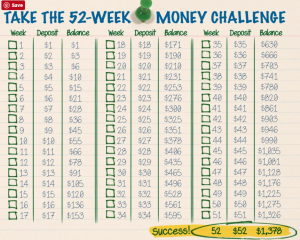
52 Week Saving Challenge

Can you save three dollars this (third) week of January? OK, can you save four bucks next week?

The 52 week saving challenge was put out by the budgetnista blog. The challenge is to save a dollar in the first week, and add a dollar for each week after that. You’ll have almost $1,400 saved at the end of the year – one dollar at a time. I don’t know about you, but that’s a lot of money, and it starts with a buck.

Yes, it’ll be harder in week 40, because you’ll be saving around $200 or so come October. But is having a $1,400 savings account worth it? Only you can decide.

I Was Inspired, I Messed Up, I Was Surprised, and Have An Idea

I was inspired: On December 7th, someone walked into the Walmart in Bedford, Pennsylvania and dropped off a bank draft for $46,265. It was an anonymous Christmas present in paying off 194 layaways at the store. Clearly, layaways are done by people who can’t afford to pay the full balance of something at the time and thus pay it in small installments before taking possession. It’s not the first time this person has done it, and sure made the Christmas of 194 people.

I messed up: We all know better, but make the number one rookie financial mistake, so I’m not alone. I was in a national retailer last week and saw AAA batteries on sale at 50% off. Half price for a package of 10. I grabbed them, paid, and left. The next day I was at Home Depot and saw the same brand of AAA batteries at the same sale price, but a package of 48 and not 10! YIKES. The first chain’s 50% off may have been legit, but they were still charging 480% more than Home Depot! How often do we look at the 50% off sign and buy without having a clue if it’s a good price or not! I did return the first ones, but it was a good lesson to learn over and over again: It’s the price you pay, not the discount you think you’re getting!

I was surprised by a survey last week that found 63% of us admit to re-gifting something. I think it’s probably way higher, but at least a lot of us are prepared to admit it. I’m in that group and there’s nothing wrong with that. If it’s a gift that you don’t need or want, it’s new, and it’s something another person would really enjoy, why not? Plan B would be to throw your gift out or give it to the thrift store and then buy the same thing again at retail price? That’d just be dumb…

And my big idea for the week will work great if you have young kids. Change one of the names of your friends in your phone to read Santa. Then have the person send you the odd text asking how the kids are behaving. I bet it’ll work like a charm…maybe even year round…

Borrowing Doesn’t Come With Warnings Or Permission Slips

When we borrow money, get the student loans, two or three credit cards, or line of credit that won’t be paid off for an average of 16 years, we just need a decent credit score and a paycheck. Nobody talks us through it first, nobody (especially the lender) gives us any warnings, and we sure don’t need a permission slip to jump headlong into debt.

To explain that, I want to play a TV commercial for you. This is an ad for Cymbalta. I’m not picking on them – these commercials are all pretty typical by law. But I want you to really listen to it. I want you to count how many warnings there are embedded in this one minute ad. Are you ready? (You can click this youtube.com link for the ad:

https://www.youtube.com/watch?v=zEP52ezHXyg&feature=youtu.be

What did you come up with? In total there are more than 25 pretty serious warnings in this ad. I used one for an anti-depressant because that seemed appropriate when our debt levels keep rising, almost half the population couldn’t find $400 for an emergency, and two-thirds couldn’t miss one week of pay without serious financial trouble.

The point is that this is an ad for a prescription. You cannot even get it filled without first seeing a doctor. A professional with at least six years of medical training has to examine you, explain it, and then – maybe – write the prescription.

Do you see the irony of this? You cannot just go get this medication. Yet, in the world of borrowing, there are way more than 25 warnings that you really should know. But nobody does – few people asks, because they don’t really know what to ask, what to avoid, how to negotiate, etc.

THAT is the reason the Money Tools and Fighting Back book is so critical. It’s the medical warning equivalent for every type of borrowing and then the part of paying it off. Lenders have no obligation and no interest in having you financially educated – none!

Whether you’re 18 or 80, the book is THE best present you will ever get for yourself, or gift to someone. The $20 for the book turns into tens of thousands of dollars. It’s a must-have and must-read until lenders have to provide the same warnings as drug companies do.

80% of teenagers never take a class on financial literacy, then we set them loose to sign for student loans, then their first credit card, then they sign for a bad cell phone contract, and not long after that, for a car loan with no financial knowledge. At some point, they may get a mortgage, and the 70% chance they’ll sign up for a line of credit, too. By the time they’re 40, they’re broke, have no idea how to dig themselves out, or what to do. Then, they have kids and pass zero financial knowledge onto them. It’s true: 80% of parents do not talk to their kids about money and finances.

Norwegian Cruise Lines – Hello from New Brunswick

Greetings from New Brunswick!

Yes, I made it all the way to the Canadian Maritimes this week with Norwegian Cruise Lines.

We’ll talk about the economy here in the Maritimes next week, but, since I’m on the Norwegian Dawn (my second time on this ship), it seems appropriate to talk about the cruise, first.

Friends of mine have called Norwegian my girlfriend. I love them, being on my 15th cruise with them. But, sadly, Norwegian doesn’t love me – or any passengers – back anymore. About two years ago, they merged with Oceana. Since that time, the cost-cutting measures have been many – and noticeable – and continue to this day.

Being sold happens on every cruise ship – on every cruise line. But cut backs, right now at least, is the specialty of Norwegian head office, from the small to the big. Six mid-level executives, including casino executive and their media relations department, haven’t replied to questions or feedback in the last two years. I also haven’t received a post-cruise questionnaire in over three years. Whether it’s perception or reality, Norwegian no longer seems to care about passenger feedback.

No more lobster in the fanciest and most expensive restaurant on ship, Cagney: That news was delivered by an embarrassed waiter during my (about) 40th visit to the restaurant. Upscale is gone – money saving is in. Free breakfast in your room…but I’m not sure what’s free about the fine print of an $8 service charge now. The room stewards seem to have more cabins to do as the quality of the rooms has noticeably deteriorated. But that may just be my cabin: I didn’t notice until the first morning that my sheets had blood stains on them or that the water glasses in the bathroom were incredibly dirty. Used glasses, dishes, etc. no longer get removed at turn-down service, but stay in the cabin until the following day. My deck has popcorn stuck on it from the previous passenger, or the one before that, or the one before that, as well as quite a bit of hair everywhere and definitely hasn’t been cleaned for some time.

Some time ago, Norwegian rolled out a program to entice you to book with them. No business wants to lower their prices, but does have to give you something to speed up your decision making process. Norwegian lets you pick from a number of add-ons, depending on the cabin type. You can pick an internet minutes package, $50 towards cruise excursions in each port, or unlimited dining and beverages. The latter two are the most popular, and the two I consistently choose. Unlimited dining was any restaurant for all six nights at sea. That became four, and has now (surprise!) become only three! And it’s not disclosed when you book!

Unlimited beverage now has you pay a $120 US dollar “fee” for it at your time of booking While it may still be a deal (go for it – it’s not as though you’re driving the ship!), it appears bar staff have been instructed to slow you down, or to make it difficult or frustrating to utilize.  While you can’t order a double (sorry heavy drinkers…) you now can’t order two drinks inside a certain unknown period of time. My guest and I ordered a shooter. and another one a few minutes later. No, you can’t do that is what we were told…by two bartenders already!

On the positive side, I can’t tell you much about the Norwegian Dawn since Media Relations didn’t reply with a simple fact sheet. It’s a mid-size ship that’s just gone through a month of renovations. This Quebec City to Boston cruise has three stops in the Maritimes, but only runs four times in the fall before going back to its regular Boston to Bermuda sailings. If you’re a senior, this week’s Maritime cruise has an average age of 66, according to one senior staff member, so you won’t be alone. If you’re not a senior, no worries – their Boston to Bermuda cruises average age is in the 40s, and the L.A. to Mexican Riviera cruises attract an even younger demographics. You’ll enjoy the enhanced variety of entertainment with something for almost everyone during the week.

If you’ve never been on a cruise before, what are you waiting for? But be careful, and book your first two with a professional travel agent. Different cruise lines and different ships have very different clientele and personalities! If you still want to test-drive Norwegian, I’d recommend the Jewel, the Pearl and the Dawn, and that you avoid the massive 4,000 passenger ships. Make it one cruise on Norwegian, maximum and avoid their loyalty program. When businesses say that you can’t put a price on loyalty and loyal customers, Norwegian can. It’s six dollars. Twelve or so cruises get you a status that includes a free dinner with bottle of wine. But the most recent cutback is that my second appetiser would be at my cost, and is now on my room charges. (You need to read the: Loyalty is Dead story we did a few weeks ago…)

With that, I have to go and now find some lobster here in Saint John. And remember, as always, you can find my previous cruise stories on yourmoneybook.com by searching the “radio stories” link.