Category Archives: Blog

Ford’s $5 Billion Dollar Bet Pays Off This Week

Today (Monday 4/25/22) Ford will deliver it’s new F150 Lightning. It’s an electric vehicle that’s part of Ford’s $30 billion electric vehicle spending to 2025. If you’ve heard about it all weekend, it’s because Ford is taking the marketing approach of Tesla for the rollout and the first delivery.

Nothing matters more to Ford than the F150. It’s not only the largest selling truck, with brand loyalty more so than the entire Ford name. Buyers of the F150 are incredibly loyal. They don’t trade for a Ram or a Chevy, they tend to be loyal to F150, often for generations. The release of the F150 Lightning this coming week is a bet that’s already paid off for Ford. Their original projections (and production plans) were for 40,000 vehicles. Their order-bank is already at 150,000 and growing and the reviews have been beyond anyone’s expectations.

Yes, it’s electric. If you were someone who made fun of (or envied) the little Prius you passed on the highway with its 50 MPG, this Ford truck – yes, a work truck – will have a EPA rating of 68 MPG. An electric truck rated at 68 MPG! Sure, lots of people and businesses, to whom this truck is targeted, will still have range anxiety and may wait and see. But it might not be for long with the obvious gas cost savings and lowest cost of ownership of any Ford truck. Plus, “it hauls ass and tows like a beast,” according to Ford CEO Jim Farley.

A 15.5″ touchscreen and 11 outlets that can power anything and everything on a job site – and can actually power your house for three days in the event of an outage! In North America only around 5% of vehicles are electric. That’s less than a quarter of Europeans, but the F150 Lightning might be a real game-changer.


Blame It On the Rain

That was the name of a song by a late 80’s R&B duo called Milli Vanilli. It turned out that they were just lip-synching – including their appearance at the Grammy Awards. In the worlds of one of the group “we were in constant fear of being discovered.”

The group didn’t last, but the blame-game and flagrant misleading (OK, lying) is alive and well. It happened within a month of the Covid pandemic in March of 2020 with a lot of businesses blaming Covid for anything and everything.

Within 10 days of the Russian invasion of Ukraine, US President Biden was blaming rising gas prices on Russia calling it the “Putin price increase.” It’s total b.s. and a poll done last week showed that less than six percent of respondents blame Russia, but the line keeps getting used. Oil was already around $90 a barrel before the war, then went to around $100. Nice try, President Biden. But someone has to be blamed when people get mad.

Politicians have no control over oil prices or supply chain issues. They also don’t have control over the weather tomorrow – honestly! Sure, in the US, voters can blame President Biden for not even getting his calls answered or messages returned by the Saudi government for weeks at a time. Oil is a world-wide commodity. The only way the price drops is when the supply exceeds the demand as every person would have seen in the past two years. Cut the demand of any product and the price drops. Increase the demand without more product and the price jumps until equilibrium is reached again. Economics 101.

But whichever party is not in power blames the current administration and claims they would deal with this. You know it’s b.s. when they don’t actually tell you anything about how they would do that. Yet it works. The current party blames someone – anyone while the opposition blames the government.

Milli Vanilli may have been in constant fear of being discovered, but sadly, businesses and politicians don’t have those same morals when it comes to blame, excuses, evading responsibility or the likes. Stuck in between are the voters who don’t really care who is to blame, but care a lot that it’s addressed. Or at least that someone understands.

How to Complain to Get Results

As I’m now in the middle of a bunch of problems with Amazon, it occurred to me that most people don’t really know how to complain effectively. Oh, sure we complain, but you need to do it in a way that the business will help you, refund you, fix the issue, or even just pay attention to you.

We typically call the 800-no service number and get mad. And after we give them a piece of our mind, we often end with “I’ll never deal with you again.”

What’s the point of working to make you happy just to have you deal somewhere else?

If a relative needs help with something, would you? Of course! You know them, like them, they say please and thank you, they’re grateful and you feel great that your time and talents made a difference to someone. THAT is what you need to remember when you call the 800 number. You’re dealing with someone that will take 50 to 100 or more calls in a shift, makes maybe $15 an hour, has supervisors pushing to deal with stuff quickly, and has been talking to mad people, many of whom lie, for six hours already.

Always stay calm, don’t raise your voice, don’t threaten, stick to the facts, and start with a one-sentence statement of what you want. Say please, and be pleasant, and tell the person you really appreciate them helping you. That will solve 75% of your issues. Do write down the date, time, and name of the person you’re speaking to.

Step two is to escalate the matter if you’re running into a brick wall of no help. Find a vice president of customer service, marketing, your bank’s regional manager, or whatever area your complaint falls under. Go online or ask one of your kids to do it for you. You want the contact information for a regional manager or vice president. The CEO isn’t calling you back, but one or two levels down, that person will pass your SOS request to someone that WILL fix it for you – guaranteed.

Send an email or a letter – one page tops. Again, write what you’d like at the top, remind them how loyal you’ve been and how shocked you are that such a great company hasn’t fixed this for you. Include the dates, times, and who you called already, with no results. I’ll guarantee you’ll have someone get in touch within 24-hours!

With Amazon, I found the email for the Canadian VP on Linked-in. The next day I had $60 refunded on my seller account, and someone from his office on the phone.

With my cable company, and the world’s slowest internet, the Vice President’s office had a “special issues” incredibly helpful supervisor call me from their BC office the same day, and a technician was at my house the next morning, with a follow-up visit, and a call every week to see how my internet was now performing.

Stay focused, factual, calm, and nice and you’ll get what you deserve. You really do catch more flies with honey than with vinegar.

My $20 Trip Halfway Around the World

OK, so it wasn’t me that traveled from India to Canada, just my two canvas prints. If you have any doubts as to how interconnected our world is, and how critical global shipping, and thus the supply chain for almost every company, this trip is a great indicator.

Two weeks ago I talked about having to order two canvas prints online because I couldn’t get close in price attempting to shop local. Just scroll back a bit to find the story. Fast forward to last week when Fedex delivered the prints. I had purchased from CanvasChamp (Scarlet Prints LLP) previously, so I was familiar with their pricing, hit and miss customer service, the need to look online for coupons and discounts not found on their home page, and that their production is done in India with websites in the US, Canada, Australia and pretty much most countries making you think you are, in fact, buying sort-of local.

Since Fedex was late in their delivery, it was purely by chance that I tracked my order with them. That was worth it – and quite the eye opener!

Yes. You’re seeing seven stops covering half the world for my 4 kg (9 lb) 77x77x5 cm (31x31x2 inch) package: From their plant in Ahmedabad, GJ, India to Mumbai, India 524 km. Then 1934 km to the Fedex hub in Dubai, Arab Emirates and on to their main Europe hub (Somma Lombardo) in Italy – another 6083 km stop-over. From Italy, my well-traveled order went to their US Hub in Memphis 7894 km and then onto Richmond, BC, Canada (2508 km) for the last customs clearance before the 7th flight of 1156 km to Edmonton International Airport, and an old Dodge Caravan from there to my house.

A trip of more than 20,000 km (almost 12,500 miles) for an order that cost me just over $70 including shipping! The world really is a very small place and incredibly inter-connected and inter-dependent. In the case of this order, and the vast majority of what we purchased from Walmart, Amazon or any Dollar Store, it is necessary to get the prices we pay. The map for towels from Walmart or wrapping paper and food containers from the Dollar Store would be the same – it would just be containers, shipping routes and a lot of ocean maps!

When politicians and economists talk about doing away with this globalization, are they just telling us what they think we want to hear or are they serious? Because I haven’t heard anyone give us the heads up that it would mean a double or tripling of prices, and a Dollar Store that’ll have to be called the Five Dollar And-Up Store…

2+2=4

Happy (almost) grad season! But that can be high school, post-secondary or lots of us adults graduating to financial adulthood. While 2+2=4 may sound simple enough, it’s not as much of a math example, as a reminder to use basic common sense. It’s actually a huge poster in the office of a Wall Street investment guru.

In other words: if it doesn’t add up, be careful, because there’s something wrong. But how many times do people not stop to think before investing, before borrowing, or making some really bad financial decisions? Here’s are some really common ones:

You can borrow your way to wealth. Sorry, no matter how great the rate, borrowing is debt and that’s the total opposite of building wealth.

You have received an inheritance of $25 million from a distant relative if you just send some money up front to Nigeria. Come on…get real…

I don’t need to start saving for retirement for few years. Ah, the common sense of delaying. If you’re 20, $9,300 will turn to a million at retirement. If you wait until 45, you’ll need $150,000. If you wait until 55, you’ll need almost $400,000. So if you agree that 2 + 2 = 4, are the odds better you can save $9,300 or $150,000 to $400,000?

Leasing a vehicle. You pay for three or four years and then just return. All those years of payments and you’re taking the bus home or starting another car rental cycle.

An internet start-up company email tip. Their stock tripled or more within months, with no earnings, and in business less than a year or so. It’s now ready for the crash… as soon as you invest.

Trying to outsmart the entire investment world by jumping in and out of investments. Computers sell billions of dollars of stock trades a day and try to gain one-tenth of a second on one another. But you think you can do it for an hour or so with information that’ll be hours old. That’s why day traders lose money 93% of the time.

You have a chance to get in on a 20% investment return. OK, parking your money at the bank gets you around half a percent. Does 2 + 2 equal 4 when someone is promising you 40 times a safe return?

Many ads for a ton of products or services promise something for nothing. Does that seem logical? Does that add up? The weight loss industry advertises like crazy in January for your New Year’s resolutions and now for bathing suit season with all kinds of promises…in a business with a 99% failure rate.

Maybe our formal schooling has stopped, but the learning can never ever end, or you’re in big trouble growing your career, just as much as your money.

Amazon Vs Walmart: Your Wallet Will Thank You

One thing is certain: Most of us shop at Walmart or Amazon at least once a month or (a lot) more. One is pretty convenient to get to and one is just a few clicks away on your phone. Which one you drive to or click on is becoming more important to your wallet. Because, if you don’t comparison shop, it’s going to empty your wallet rather quickly.

From its inception, the goal of Amazon was to dominate the market with low prices. But that ended, or rather it transitioned, to convenience quite some time ago. With a reported 100 million plus people having Amazon Prime, there is an entire generation that values the convenience of two clicks to buy and guaranteed next day delivery. Amazon is banking on the fact that those prime customers don’t shop around much – and they’re right.

Convenience trumps price – just like the closest ATM with a four dollar “service” charge trumps free withdrawals at our own bank three blocks down the street. As we’ve talked about more than three years ago, Amazon isn’t the least expensive on identical products almost half the time (according to studies originally reported by US consumer guru Clark Howard.

Walmart also has some weird pricing on their website. Most of it appears to be from third-party vendors (which is also the vast majority of Amazon’s inventory. Here are some of my shopping attempts and price comparisons from the last two weeks:

Yesterday I bought the pretty plain Remington R3 razor at my local Walmart. I thought $40 was a little high, but bought it anyway…until I got home and checked Amazon! $118 total vs. $40 is insane!

The legal rip-offs for those not bargain shopping works the other way around, too. This is a simple 10 pack of plastic cover plates for light switches: $15 from Amazon vs. $64 from Walmart for a 12-pack!

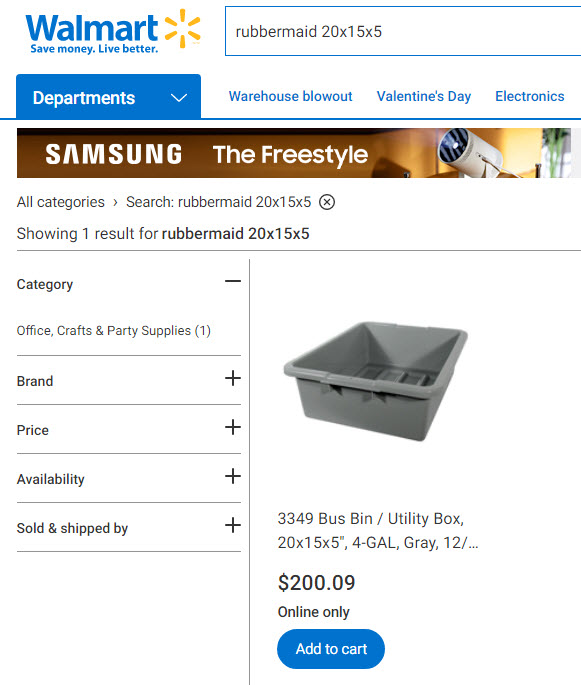
A gray bus pan that restaurants use to clear tables: I needed two of them since they’re great for the garage. But I almost had a heart attack seeing the Walmart price of $200…for something I bought at Costo Business Centre for $6.

There were a few more of my purchases – or purchase attempts – from the last few weeks where either Amazon or Walmart weren’t even close. While these may be obvious, it’s the 20 smaller things you buy where the prices are “only” out 10 to 20 percent that don’t make it onto our “better double check that price” radar. And that’s what both of these giants, and their third-party vendors count on. At a time when it seems like everything is already up in price by at least 10-20 percent, take the two minutes to compare prices. Your wallet will thank you!

3 Short Stories

Instead of putting their product on sale, Pizza 73 is advertising limited edition (Edmonton) Oilers game box pizza. If you’ve ever wanted to collect used greasy pizza boxes, don’t miss this promo!

Twice last week someone asked me when governments will be back to some kind of balanced budgets. Being asked that is very rare – it’s not something that most of us do as individuals. Hands up if you even do some kind of budget… Hands up if you remember any talk about that in the last two elections? There wasn’t anything. But many remember Prime Minister Trudeau’s comment that “budgets balance themselves.” Besides, running deficits allows politicians to buy votes. Getting to balanced budgets costs them votes!

Middle of January I saw a Royal Bank ad promoting investment accounts for RRSP season. The “deal” was that you get 100 free trades until March 31st. If you need more than two or three trades in the first two months, you’re doing something wrong! You’re not a day trader, I hope, because 93% of them lose money. I manage a 7 figure investment account for a relative. It’s with a national portfolio manager in five accounts. Last year they did a total of 16 transactions. That’s three per account in a year! 100 trades should last you more than 30 years…if you’re investing and not churning, guessing, or day trading.

What to Do When “Shop Local” Doesn’t Work?

I am a big proponent of buying local – always have been. However, this past week it’s been nearly impossible. Yet, I still feel bad, in spite of the fact that there really wasn’t a choice.

For the past two weeks I’ve been waiting for any of the seven glass places to email me a quote for a custom-cut piece of glass shelving for my discontinued closet shelving colour (thanks for nothing, Ikea) None of them chose to respond, so I didn’t have a choice but to go back to Ikea.

Tuesday I had more luck…sort of: Needed a 16×20 inch mat with cut insert to re-frame a picture. Michaels (I believe) still outsources these to Toronto. But I found a local picture shop where the owner told me he’d have it done in an hour. It wasn’t a rush, and I was OK with paying $25. Quite an over-payment, but that was fine with me…sort of…

Last on my list was to replace a 30×30 inch canvas. I purchased the picture from Shutterstock (if you ever want to upgrade any pictures in your place, check them out!). Now needed the print on canvas and stretched onto the wooden frame. Seemed easy enough – besides, there’s a local company where the owner had done two large ones for me in the past. Well…not so much now: Three weeks today and no response to my e-mails. Pretty clear he’s not interested in the business. The downside is that I could only find one other place that’s local and has a canvas printer! No worries – I know the man and I’m sure that plan B will work.

The price quote was WHAT? Yes, they quoted an inch and a half larger for some unknown reason, but that amount didn’t seem right. Thus, I was forced to now go online to one of the two big canvas print suppliers. The one I’ve dealt with before has a dot ca website, making you think they’re in Canada. However, it’s an Australian company and the canvas prints are done in India (the sticker is on the back of each product). With a coupon for “buy one get 2nd free” I was able to order another custom canvas and the total amount was $78 total for both! That same order for two items would have been about $600 local vs. $78 offshore.

I don’t want to live in a world – or a city – where retailers don’t exist and we’re forced to deal with Walmart or Amazon – ever! But when nobody gets back to me, or the price is so off, is there a choice but to shop online or at a US (or Swedish) owned big box store? If so, I’d love to know….Sad but true…

A Family With 13 Kids AND Saving 35%

Rob and Sam Fatzinger have 13 kids, one income, and a free and clear home just outside of Washington, DC. If you want their full story, just go to the Washington Post and type in their name.

Here’s their story in short: Rob made $40,000 a year just a decade ago, but now earns $100,000, plus, and mows lawns in the neighbourhood for a few extra bucks a month. His stay-at-home wife home schools their 13 children with assistance from a tutor. In 2000, they bought a fixer-upper foreclosure with $50,000 down and paid off their 15-year mortgage early, and Rob will retire early at age 62.

They had a lot of help from the community in renovating and expanding the home. The Fatzinger’s also receive a lot of support, where friends and neighbours have helped with gift cards for food, and even used vehicles over the years. Their biggest cost is their food budget that was running $1,600 a month. Today, their savings rate is 35%.

All kids have long ago been educated to know they will not receive help with college costs. Yet, several of them have already graduated from college with part time jobs, scholarships, and ZERO student loans!

But that’s not the story. If you’re really quiet, you can hear what most listeners are thinking right now: That none of that could ever happen in their life:

Judgment and strike 1: I couldn’t buy a place for $150,000

Strike 2: I could never take on a part time job

Strike 3: I wouldn’t accept donations from people or ask for help

Strike 4: I could never do a 15-year mortgage or pay extra on it

Strike 5: I can’t save 5% of my pay, never mind 35%

Strike 6: He makes $100,000 –I don’t…

Strike 7: I couldn’t tell my kids I won’t contribute to their university costs

Strike 8: I’d never be able to retire early

Your attitude determines your altitude. Instead of the judgments and saying “I couldn’t do that” change the wording to: I’m not prepared to do that. Then at least you’re being honest with yourself. Because, people who say it can’t be done should stay out of the way of those who are doing it!

Crypto Gambling Isn’t Going So Well Right Now:

The first rule of gambling is that you’ll be down way more times than you’ll be up. The second rule is that you need to remember gamblers will tell you all the details of their run of wins and profits in the casino and somehow skip over all the previous losses.

That’s why crypto fans would just as soon forget last weekend, or spin it as a short-term correction, and a great chance to buy more… Last weekend, Bitcoin briefly dropped to $34,042. That’s a 50 percent loss since the high of last November, and a loss of $600 billion. In aggregate, crypto gamblers (including Ethereum, Solana and Cardano) lost a trillion bucks.

When you buy US dollars, the exchange may go up or down fifty cents or a buck for every $100 you buy. So, calling crypto a “currency” is, to me, a joke when it can change in value by half inside two months. But it’s kind of like pot: Vast numbers of 18 to 30-year-olds want to try it – and that’s a large group of crypto buyers right now.

Is it better that crypto had a massive drop for millennials to realize this isn’t investing, it’s gambling? I hope so. To paraphrase Kenny Rogers’ song: You gotta know when to hold them – know when to fold them – know when to walk away – know when to run. Bill Maher on Real Time (HBO) said it best last Friday:

“I think I know why you’re happy this week. It’s because you didn’t invest in crypto… I was hoping for this – it’s horrible for the environment and it’s just f’n stupid! It crashed like a rock. It lost almost a trillion dollars. I mean, people in the metaverse are jumping off virtual buildings! And you know who got it the worst? Millennials. Because they thought it was cool. And now they’re like – wait – you mean it was a bad idea to put all my savings into an imaginary currency with a dog on it? But you know what’s doing good? The ACTUAL economy.”

Investing takes time, patience, very little active trading, and is more turtle-like than meteoric. But at the end of the day, when you want to retire, you’ll actually have something substantial. An S&P 500 index fund is adventure enough. Crypto won’t get you there – sorry. Can it become something resembling a legitimate online currency? Maybe in a decade or two. Among other things, that would take massive government regulations across the globe. If it’s only regulated in a few countries, transactions would just move to offshore jurisdictions without those regulations. Right now, it’s the must-go place for people (crooks) who need (not want – need) anonymity: Drug dealers, crooked third-world leaders, ransomware hijackers getting paid, arms dealers doing their transactions and the likes. Sure, some – ok – very few – businesses accept crypto. But I would suggest that’s more for the publicity than any real quantity of business. Count me out wanting to be in the same “currency” or world as those people.

Update: A new Bitcoin vending machine in CrossIron Mall, Calgary

Update 4/12/22: A Great line from Bill Maher on last week’s Real Time (HBO): Miami is hoping to become the crypto capital of the world. Makes sense. Because, like crypto, Miami won’t be around in 20 years (with global warning).

Update 6/14/22: One of the largest crypto companies, Celsius just froze all client withdrawals. And they’re one of the largest companies! That, according to Bloomberg has now taken crypto gambling from a high of over $3 trillion last November to total valuations of less than a trillion as of yesterday. On top of that, a US report last week showed that over a billion dollars of peoples’ money thinking they were investing in crypto actually went to fraudsters. Are ya sure this is a place you want to have your money?